
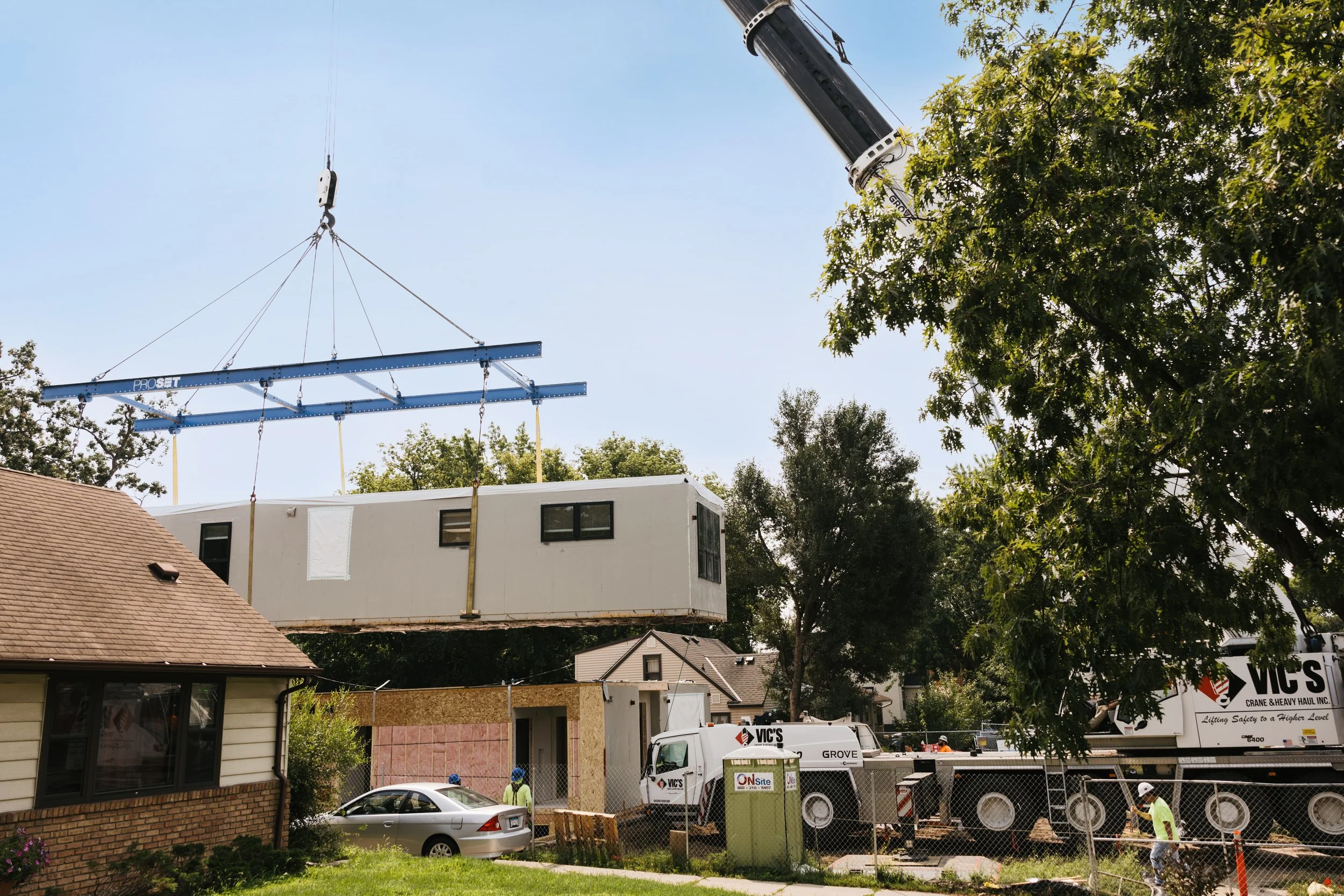
The Minneapolis Public Housing Authority (MPHA) was working on a Family Housing Expansion Project that would offer a replicable roadmap for fast, dignified, community-integrated affordable homes at numerous scattered sites that were all modular and deeply affordable. However, near the end of 2021, they ran into serious resistance from one local board regarding the entitlement process.
“We were asking a lot of the system,” said Mary Tingerthal, a former state Housing Commissioner who joined the project team. “Modular on scattered sites is a complex lift—technically, politically, emotionally. There were moments when I honestly wasn’t sure we’d make it. But what got us through was this stubborn belief that families at 30% AMI deserve the same quality, beauty, and dignity in housing as anyone else.”
Even with zoning alignment under the city’s 2040 Plan, they faced community resistance. Brian Schaffer, the MPHA assistant director of planning and development, recalls one night vividly:
“A group of neighbors invited me into someone’s living room. It was a Friday night—seven o’clock—and there I was, sitting on a couch with about ten neighbors, answering questions about who would live there, what the buildings would look like, whether their street would change forever. Some people were upset, some just wanted reassurance. All I could do was listen, acknowledge, and explain why this mattered. I walked out exhausted, but also knowing that listening that night may have saved the project.”
The Solution: Innovation Under Pressure
That mix of candor, transparency, and determination helped turn wary neighbors into reluctant supporters who at the very least, felt heard. It also demonstrated how leadership in housing innovation often means showing up in the hardest rooms.
The MPHA broke precedent with a two-step procurement process that required architects, contractors, and modular builders to team up from the start, ensuring integration of design, factory, and fieldwork. DJR Architecture, Rise Modular, and Frerichs Construction emerged as the winning team.

The project spanned 16 sites across Minneapolis, each one its own puzzle of grading, utilities, trees, and neighbor relations. Modular units, trucked through narrow streets and craned into place, cut months off build time. Families began moving in just 10 months after construction started, with full delivery in 13 months. By then, modular speed was saving MPHA an estimated $100,000 per month in avoided carrying costs.
Outcomes and Lessons
In the end, the Family Housing Expansion Project delivered 84 new affordable units, including homes for 17 families emerging from homelessness. It proved that scattered-site modular development is possible at scale, and that families can be housed faster, with less disruption to existing neighborhoods.
But it also underscored the challenges: site-specific costs remain high, and true scalability will require standardized codes, stronger procurement pathways, and aligned funding streams. For Schaffer, Tingerthal, and their partners, the project is both proof of concept and a call to action.

“Every part of it was hard,” Shaffer said. “But we built something that shows other housing authorities this can be done, and it can be done with speed, dignity, and community trust.”
Lessons for Other Cities
Trust is Foundational MPHA built credibility by engaging directly with neighbors, demystifying the project, and responding to concerns with transparency and care.
Procurement Models Matter A team-based selection process helped align architects, modular manufacturers, and builders from day one, reducing costly missteps.
Infill Done Right Can Heal By converting vacant land into scattered-site homes, MPHA avoided displacement while reinvesting in existing neighborhoods. The deeper lesson? Innovation isn’t about flashy tech; it’s about building systems rooted in dignity, trust, and shared accountability.